Well, it looks like the citizens of Grafton want to keep the Bridge Street Dam where it is. The binding referendum passed April 5th. "Should the village preserve the Bridge Street Dam until at least 2019, a state imposed deadline for demolishing, upgrading or replacing the structure."
1,685 people, or 75%, voted "Yes!" No votes came in at 573, or 25%.
The Riverkeeper is disappointed. “These dams are very expensive to maintain,” she said. “They’re not necessarily providing a lot of benefit other than recreational or aesthetic," noting that stimulus money could provide funds to replant the mud flats, to create a riverside green space with trails. I'll just note here that a year after the Estabrook Dam's been not damming the river by us, the riverside green and brown space is a swath of unstimulussed mud, weeds, and plastic bags.
Look here for some aesthetic possibilities.
Good for you, Grafton.
Showing posts with label dam removal. Show all posts
Showing posts with label dam removal. Show all posts
Thursday, April 8, 2010


Sunday, July 12, 2009
El rio esta verde hoy! The River is green!
Normally, my favorite color is green. (Normalmente, mi color favorita es verde.) I could look at green all day. But, when something is amiss, worry takes precedence over enjoyment of beauty. It looks like St. Patrick's Day in Chicago!
 Algae bloom on Milwaukee River west of I-43. Photo taken July 11th, 2009. The only alteration to the photo was cropping and resizing- no color-correction, brightening, etc were done. El rio esta muy, muy verde, verdad!!!
 Algae bloom photo taken July 10. Again, no color change or brightening were done to this photo.
I made sure to take photos at two different times of the day, at two different light levels. I only wish I could also capture the foul odor. Someday, computers may be able to transmit such a thing.
We have been told that a damless river (which it is, in effect, now, since the dam is not holding back any water) would be a healthier river, and not prone to such unpleasant phenomena. But as you can see (and smell) for yourself, this is not the case.
 Algae bloom on Milwaukee River west of I-43. Photo taken July 11th, 2009. The only alteration to the photo was cropping and resizing- no color-correction, brightening, etc were done. El rio esta muy, muy verde, verdad!!!
 Algae bloom photo taken July 10. Again, no color change or brightening were done to this photo.
I made sure to take photos at two different times of the day, at two different light levels. I only wish I could also capture the foul odor. Someday, computers may be able to transmit such a thing.
We have been told that a damless river (which it is, in effect, now, since the dam is not holding back any water) would be a healthier river, and not prone to such unpleasant phenomena. But as you can see (and smell) for yourself, this is not the case.
I am not a biologist. I do not know if this is the infamous "blue-green algae" that kills dogs who consume it- but I certainly hope not, as I have been watching two lovely deer on the other bank munching on leaves and presumably drinking water also. Perhaps the Riverkeeper can tell me. I am about to send her an email.
Saturday, May 9, 2009
Root River Parkway
It is interesting how powerful rivers are, and how fickle- they can flood, change course, divide off an oxbow into a separate lake, and often quickly.
 Satellite photo of 42* 50’ 23.97” N 87* 53’ 28.51” courtesy of Google Earth
Fa Ross has told me about an area of the Root River Parkway in Racine- a wild, natural river area. He has hiked there often over many years and sent these photos of the natural damming provided by trees and debris floating downstream, aided at times by hardworking beavers. He believes that if the Estabrook dam is removed by the DNR, that the natural Milwaukee River state in the affected area would be unstable and unpredictable. 
Photo by Fa RossHe described a time when, during a period of spring flooding, he watched the river change course to the west, over a period of hours, as it found a new way around a pile of debris. He offers this for comparison between the two rivers:
To my knowledge there has never been a dam in this area of the Root River. I think this area is an excellent example of what Lincoln Park will look like in 10 years or so. Yes, this area is very beautiful in its own way, but you will notice the lack of large trees and the many standing dead trees, pools of stagnant water and piles of logs, sticks and garbage. In the last 30 or so years, many homes have been torn down along the Root River due to the massive flooding, compounded by the dams the trees and ice make with much help from the beavers.
Photo by Fa Ross
There is a 7 foot high by @ 15 foot long wall of sticks and logs that has formed sometime in the last two years and is forcing the river to cut a new channel.
The most graphic example of what I am talking about is approximately one mile north of this on County Line Road, but the last time I drove by it had a No Trespassing sign up. (Part of this area is a superfund cleanup site.) If you have Google earth you can see what I think is a giant beaver dam made of garbage, that used to be there, around 42* 50’ 23.97” N 87* 53’ 28.51”- see below, the middle of the screenshot.
The most graphic example of what I am talking about is approximately one mile north of this on County Line Road, but the last time I drove by it had a No Trespassing sign up. (Part of this area is a superfund cleanup site.) If you have Google earth you can see what I think is a giant beaver dam made of garbage, that used to be there, around 42* 50’ 23.97” N 87* 53’ 28.51”- see below, the middle of the screenshot.
Satellite photo of 42* 50’ 23.97” N 87* 53’ 28.51” courtesy of Google EarthIf you are interested in seeing this for yourself, here are Fa's directions: Take I 94 south (aka West) to Seven Mile road in (1st exit in Racine county) head east @ 4miles. Just after the second set of rail road tracks you will cross a bridge over the Root River . On the East side of this bridge you will see a oversized gravel shoulder park there. You can walk on either side of the river to the south for @ 1 mile. The park is only 20 or 30 yards wide and is usually used as a bridal path.
Thursday, March 12, 2009
If I weren't so pissed off, it might be funny.

To be fair, the writing in Lee Bergquist's article "Estabrook Dam earns praise from neighbors" could have been even more biased. Of course, it was based partially on the flawed and biased Matrix the County put forth with The Report: data that misrepresents and underestimates the true cost of removing the dam (and associated rechanneling of the river). It's just that the costs would be partially borne by the Federal and State government, rather than all by the County. PCB remediation will continue either way- a good thing.
Wednesday, March 11, 2009
Increased fish diversity-- good news
 Will Wawrzyn of the DNR spoke at length yesterday at the PEE Committee meeting. I was particularly interested in what he had to say about fish diversity. He had a powerpoint slide showing that there was a jump in total number of species and total number of native species in the North Avenue Dam site in 1997 (the year of partial removal, though it had been open since late 1990.) I tried to find this specific slide online, but I found better: this 2005 DNR report that discusses the subject at length. In particular, I wondered if the increase in fish diversity and number was as much or more due to the abatement, removal, and washing out to the lake (since the dam was open for sediments to wash though) of PCB's, heavy metals, and whatever other contaminants had settled there.
 Changing Habitat and Biodiversity of the
Lower Milwaukee River and Estuary
"The Kletzsch Park station is an upstream site, [upstream from the Estabrook Dam also] which was not influenced by the NorthAvenue Dam impoundment. The upstream end of the station is fast flowing riffle, immediately downstream of the Kletzsch Park Dam (see Figure 5). The downstream section has some deep holes, and glides with overhanging tree branches, large boulders, and undercut banks providing fish cover. We recorded a total of 29 native species in five years of sampling, ranging from 11 species in 1996 to 23 species in 2001(Table 7). We could not sample this section in 1997 due to logistical reasons. Common carp was the only exotic species captured. The few walleye that were captured belonged to the recent stocking effort, demonstrating that the stocked walleye swim past the Estabrook Falls and Dam. Almost all the species captured at this station were also found in the Capitol Drive station except an occasional brassy minnow and fantail darter. At least seven species occurred consistently in all samples – spotfin shiner, common shiner, sand shiner, bluntnose minnow, rock bass, smallmouth bass, and logperch – although the numbers differed from year to year."
Keep in mind that the Estabrook Dam is located between the Capitol Drive sampling site and the Kletzch Park site.
"Other dams on theMilwaukee River including Estabrook, Kletzsch and Thiensville should be studied to see if removal or fish passage can be accomplished with minimal impact to the environment and conflicts with different user groups in those areas."
Photo taken by me in October, 2007. I photographed what I thought was a random fisherman, and when I asked him a question about the area, I realized he is a man I work with. What a small world we live in.
Monday, March 9, 2009
Open letter to Milwaukee County officials
A neighbor on the river sent this to me- I thought it summed up eloquently what a lot of people are thinking. She graciously said I could quote her here:
"On Mother's Day in 1997 I saw a cottage for sale in Glendale on the Milwaukee River. The balance of urban life in a setting of trees, river, and wildlife was the life I sought. Over the past 11 years, I have restored and improved my property, and after a day's work I would enjoy a rest down at the river, waving at the boaters and sharing a quick hello. Over the years I have noticed a doubling of the boaters and paddlers. I watched the river rise during storms and shrivel during droughts. I have marveled at the ducklings in spring, the geese in fall, and thrilled to see the herons. I have engaged in the life cycle of the river, supported and enhanced by the Estabrook Dam.
Prior to moving here, I lived on/near the Milwaukee River north of the North Avenue Dam.
There, too, as I was working on my property, I would hear the crew boats coming down the river. Shorewood had built a boat house for them and they practiced every Saturday. Then one day the river was gone. The dam had been removed (it seemed overnight and with no notice) and the mighty river and the community it supported became a muddy ugly stream. To this day it is still a diminished river, unapproachable, and abandoned.
I am telling you these personal stories as I understand that a similiar process is being
advocated for the Estabrook Dam. I have gone to the meetings, and read the report prepared by the Riverkeepers. I wonder who funds the Riverkeepers, with their executive director, newsletters, offices, and 14 page reports. I don't recall electing these people to represent me. I do recall electing county supervisors. I rely on the elected officials to provide a balance to the debates remembering the local paying public who is funding these debates and the managent of this resource.
I do know two things. My property value will go down along with the dimise of the river from its current glory. A respected real estate agent in the Glendale community has predicted the home values will diminish by 50%. Between what you are being asked to do and what Wall Street has already done, I will become part of the problem facing our country. My house could be worth less than I owe.
I have also looked at the pictures provided by Riverkeepers of other 'improvement projects' on dams in this area and in Wisconsin. What happened at North Ave was not a rare instance. The rivers become a sad trickle overgrown with vegetation and no longer serving it's urban purpose. Natural river streams are appropriate in many areas. But in an urban area a river serves many functions, including accessability and recreation. It should not be a backwater which has lost its full usefulness.
Much is being said about the other citizens in Milwaukee. That fish and fishermen have rights. That people need to walk along rivers. That the homeowners are single minded, only worrying about their land. However there are three parks which border this river under consideration and are open to any citizen who wishes to picnic or fish. The new aquatic center [in Lincoln Park] was not planned to be along side a muddy stream. And finally, I am very tired of being taxed when you want my money and then ignored. Taxed and ignored."
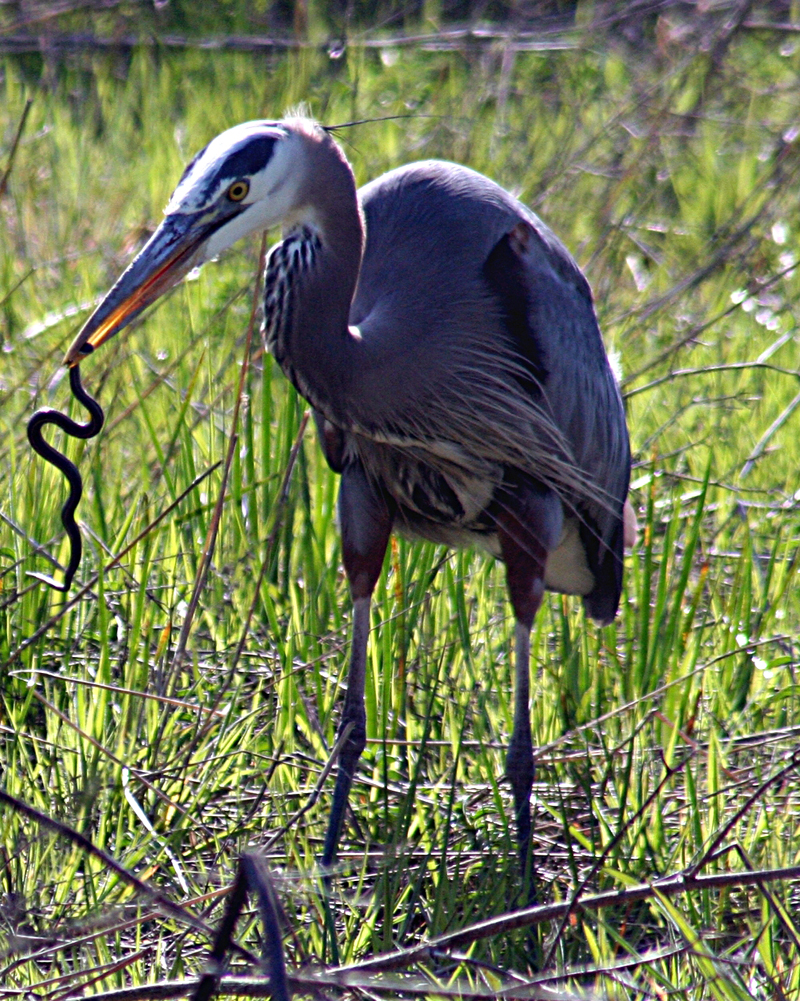
Photo of blue heron having a dinner , Tennessee Valley, California, by Mila Zinkova
"On Mother's Day in 1997 I saw a cottage for sale in Glendale on the Milwaukee River. The balance of urban life in a setting of trees, river, and wildlife was the life I sought. Over the past 11 years, I have restored and improved my property, and after a day's work I would enjoy a rest down at the river, waving at the boaters and sharing a quick hello. Over the years I have noticed a doubling of the boaters and paddlers. I watched the river rise during storms and shrivel during droughts. I have marveled at the ducklings in spring, the geese in fall, and thrilled to see the herons. I have engaged in the life cycle of the river, supported and enhanced by the Estabrook Dam.
Prior to moving here, I lived on/near the Milwaukee River north of the North Avenue Dam.
There, too, as I was working on my property, I would hear the crew boats coming down the river. Shorewood had built a boat house for them and they practiced every Saturday. Then one day the river was gone. The dam had been removed (it seemed overnight and with no notice) and the mighty river and the community it supported became a muddy ugly stream. To this day it is still a diminished river, unapproachable, and abandoned.
I am telling you these personal stories as I understand that a similiar process is being
advocated for the Estabrook Dam. I have gone to the meetings, and read the report prepared by the Riverkeepers. I wonder who funds the Riverkeepers, with their executive director, newsletters, offices, and 14 page reports. I don't recall electing these people to represent me. I do recall electing county supervisors. I rely on the elected officials to provide a balance to the debates remembering the local paying public who is funding these debates and the managent of this resource.
I do know two things. My property value will go down along with the dimise of the river from its current glory. A respected real estate agent in the Glendale community has predicted the home values will diminish by 50%. Between what you are being asked to do and what Wall Street has already done, I will become part of the problem facing our country. My house could be worth less than I owe.
I have also looked at the pictures provided by Riverkeepers of other 'improvement projects' on dams in this area and in Wisconsin. What happened at North Ave was not a rare instance. The rivers become a sad trickle overgrown with vegetation and no longer serving it's urban purpose. Natural river streams are appropriate in many areas. But in an urban area a river serves many functions, including accessability and recreation. It should not be a backwater which has lost its full usefulness.
Much is being said about the other citizens in Milwaukee. That fish and fishermen have rights. That people need to walk along rivers. That the homeowners are single minded, only worrying about their land. However there are three parks which border this river under consideration and are open to any citizen who wishes to picnic or fish. The new aquatic center [in Lincoln Park] was not planned to be along side a muddy stream. And finally, I am very tired of being taxed when you want my money and then ignored. Taxed and ignored."
Photo of blue heron having a dinner , Tennessee Valley, California, by Mila Zinkova
Tuesday, March 3, 2009
Call to everyone who wants the dam out

To everyone who signed a petition to remove the Estabrook Dam, I'll see you out on the banks every weekend in the coming summers doing stabilization and planting suitable native species to keep the inevitable carpet of buckthorn and the subsequent underlayer of garlic mustard at bay. Oh? You thought you just would get to fish? Sorry. You're not really signing a petition--it's a long-term work contract. See you there!
Subscribe to:
Posts (Atom)